
“I think my miles collection strategy is actually more mature than my redemption strategy.”
That was how one HeyMax user described their miles journey—and it will sound familiar to anyone deep in the miles game.
We know which 4 mpd card to use at each merchant. We know how to hit minimum-spend requirements, maximise transfer bonuses and squeeze every last mile out of everyday spending. One of HeyMax’s earliest features was built around a simple question: Which credit card should I use here?
Collecting miles has become second nature. Redeeming them hasn’t.
After a year or two, you might have 100,000, 300,000 or even a million miles spread across banks and frequent flyer programmes. On paper, you have done everything right. But when it is finally time to book that dream trip, redemption can feel much harder than earning the miles in the first place.
You may not realise that Avios can be transferred between Qatar Airways, British Airways and Finnair, or that some Singapore Airlines flights can be booked through Star Alliance partners such as Air Canada Aeroplan or EVA Air Infinity MileageLands.
Even if you know every transfer partner, sweet spot and award chart, searching can still take hours. You open twenty tabs, search one programme after another, compare redemption values against cash fares, adjust your dates and repeat. If you are lucky, you find the seat you want. More often, you end up joining a waitlist that never clears.
Somewhere along the way, collecting miles stopped being the hard part. Searching became the job.
Introducing Award Companion
Earlier this year, HeyMax launched an award flight search engine that lets you compare availability across multiple frequent flyer programmes in one place. It saved travellers hours, but one obvious gap remained: KrisFlyer.
For miles collectors in Singapore, KrisFlyer is often the programme that matters most. Yet Singapore Airlines does not provide a public award-search API, so KrisFlyer availability could not be included in the same way.
That constraint led us to ask a broader question: How do we build a truly unified award-search experience?
The first answer is Award Companion.
How Award Companion works
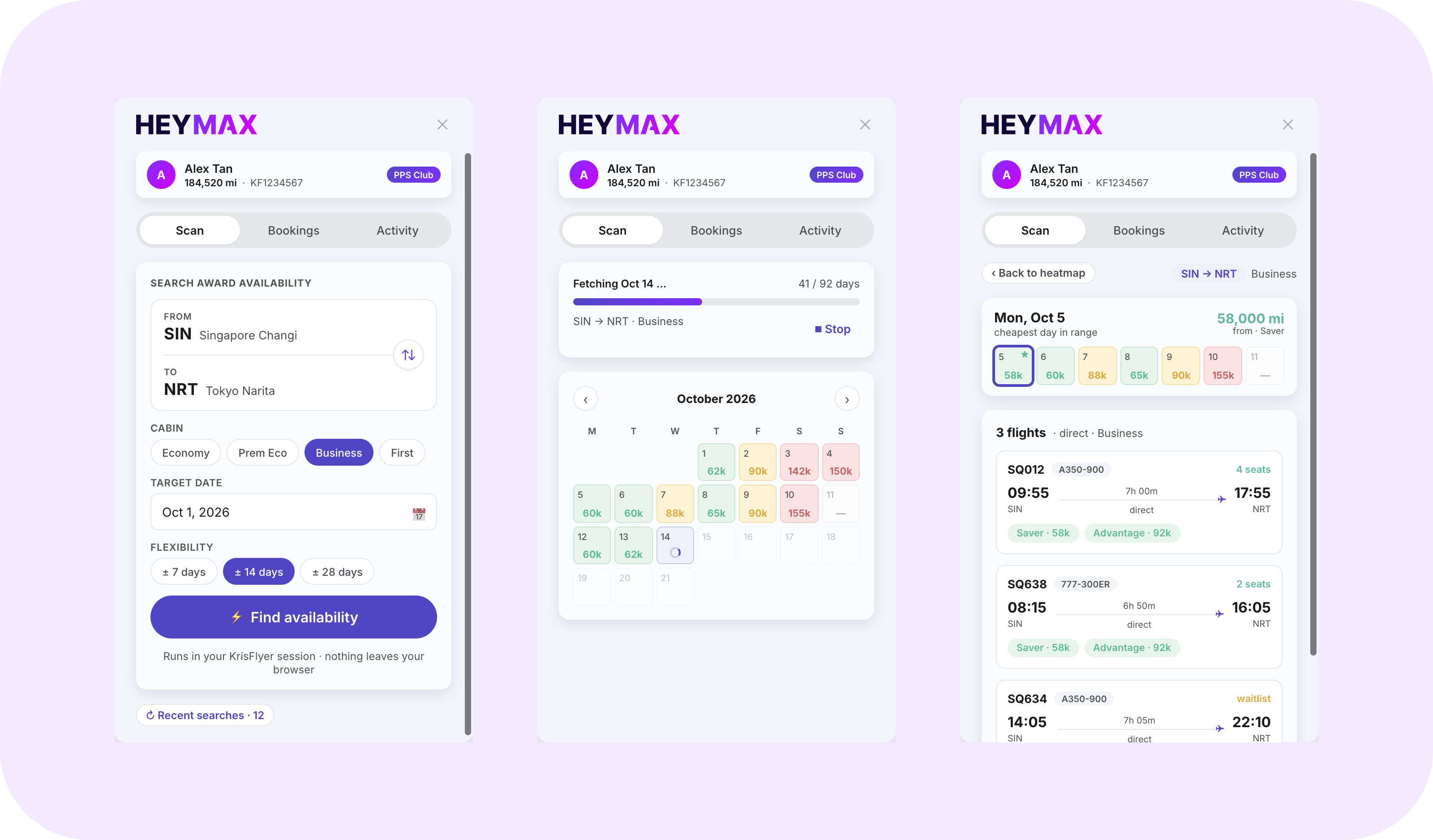
Award Companion works alongside the Singapore Airlines website. Once you have logged in to KrisFlyer, perform an award search as usual: choose your origin, destination, travel class and number of passengers, then click Search.
Instead of stopping after a single date, the Companion continues searching neighbouring dates on your behalf. It performs the searches you would otherwise make manually and gathers award availability across an entire search window.
As each search completes, the results appear in a heatmap calendar. At a glance, you can see where Saver awards are available, which dates are waitlisted and where the strongest redemption opportunities may be. Select a date and you will return directly to the corresponding Singapore Airlines results, ready to continue booking.
Every search comes from your own KrisFlyer account. If you are a PPS Club or Solitaire PPS Club member with access to additional award inventory, the Companion sees the same results you do. It uses your logged-in browser session rather than a separate database or a cached copy maintained by HeyMax.
That single view makes it easier to spot opportunities hidden behind dozens of repetitive searches. Sometimes the best redemption is only a few days away—you simply would not have found it by checking every date manually.
The platform challenges
This is not a perfectly clean or stable product to build. Singapore Airlines does not offer an official award-search API, so there is no supported endpoint that can return every available award seat. Award Companion must work through the same website travellers use, which creates several engineering challenges.
Everything happens while you are logged in. That is a feature as much as a constraint. Award availability can be personalised to your account, so the extension searches as you inside your browser session instead of routing those searches through HeyMax servers.
The Singapore Airlines website is a modern single-page application. Important details—including your selected cabin, passenger information and search state—do not all appear in the page URL. The extension must observe the application’s network activity and understand the relevant search context before it can assist.
The experience is inherently fragile. Because Award Companion is built on top of a live website rather than a stable API contract, changes to the Singapore Airlines site can occasionally interrupt it. When that happens, we work to restore compatibility.
That trade-off is also why the problem is worth solving. Many people see these constraints and conclude that the experience cannot be improved. At HeyMax, we see engineering challenges with the potential to remove hours of repetitive work.
More than a calendar
Today, Award Companion automates something miles travellers already do manually: search one date after another, compare prices, remember availability and piece everything together into a decision.
Rather than relying on a separate award database, the Companion works with your authenticated airline session. It uses your existing account, membership and entitlements to show what you can actually book—not a generic view of availability.
That approach opens the door to something bigger.
Imagine applying it across every frequent flyer programme you use: KrisFlyer, Cathay, Qatar Airways, Air France-KLM and EVA Air. Instead of opening a dozen tabs and repeating the same search, one experience could scan multiple dates across your programmes, bring the results together and surface the strongest redemption opportunities automatically.
At that point, we are no longer helping you search. We are searching for you.
Software has already transformed other high-context workflows by taking on repetitive work and leaving people to focus on judgement and decision-making. Award travel deserves the same experience.
Searching should not be your job. Deciding should.
Award Companion is chapter one.